
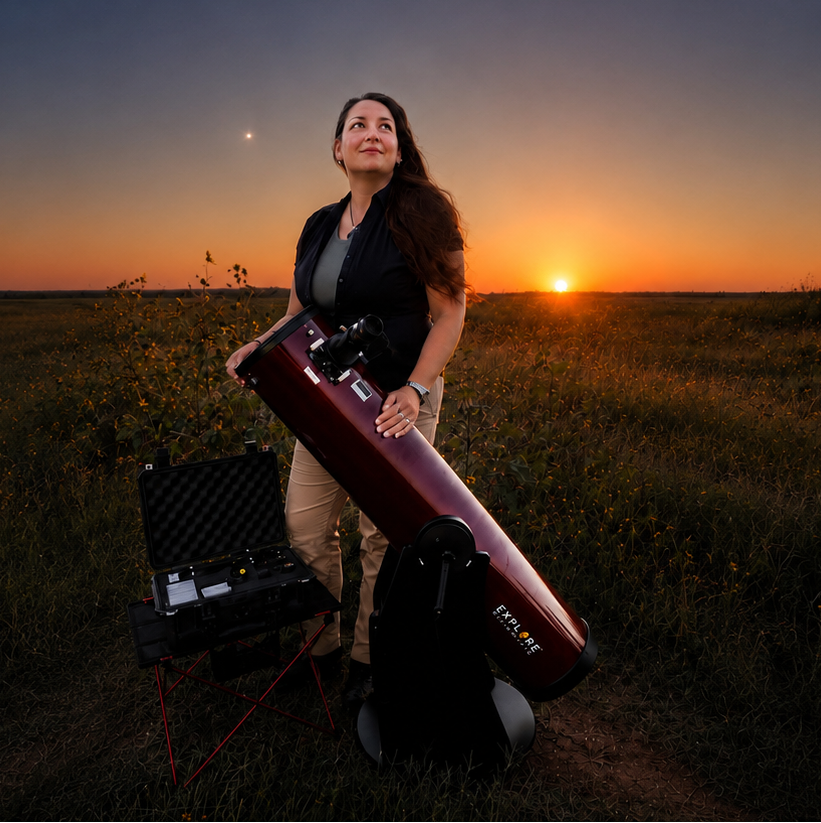


Explore Alliance Ambassadors - Diana Hannikainen - Editor in Chief Sky & Telescope Magazine

Some people fall in love with the night sky the way you fall in love with a song — not all at once, but in flashes that return and deepen over time. For Diana Hannikainen, that first spark came early, carried on the pages of Sky & Telescope itself.
Born in Finland and raised across seven countries, Diana’s childhood unfolded in motion—her family following her father’s work as a Finnish diplomat from one posting to the next. Homes changed. Languages shifted. Cultures came and went. But above it all, the sky remained constant—the one familiar roof that never moved.
It was while living in Brazil, beneath the deep southern skies, that something lasting took hold. Her father would take her far beyond the reach of city lights, to places where the Milky Way rose overhead with a clarity few people ever experience. Those nights weren’t lectures or formal lessons—they were simple moments of wonder, quiet invitations to look up and feel part of something much larger.
By day, Diana absorbed the universe through the pages of her father’s well-worn copies of Sky & Telescope, lingering over astrophotographs that hinted at worlds beyond reach. By night, those same worlds revealed themselves in silence and starlight. In that convergence—printed images and lived experience—the spark was lit, and the sky ceased to be distant. It became personal.
Then came the moment that converts curiosity into devotion: a family friend arrived with a telescope, and Diana saw Saturn’s rings with her own eyes for the first time. She’s recalled being so stunned by the reality of it — a world she’d only known from pictures suddenly present in the eyepiece — that she literally fell over backward. If you’ve ever heard someone gasp at the eyepiece and go quiet, you know exactly what that means: the universe just reached out and tapped a human heart.
Diana took that wonder into rigorous study, earning her undergraduate degree at the University of Edinburgh, where she was active in the university’s astronomical society — the kind of community where the sky stops being abstract and becomes shared culture. She later “followed the thread back home,” exploring her Finnish roots at the University of Helsinki, where she completed an MSc and then a PhD in high-energy astrophysics. Her research focused on microquasars — black hole systems that feed, flare, and launch jets, scaling down the drama of quasars into our own galaxy.
But here’s what is to be admired most: Diana didn’t stay inside one silo. While studying X-rays from these extreme systems, she built a long-running collaboration with radio astronomers at the University of Sydney, bringing different “eyes” to the same cosmic story. Over her research career, she has published extensively — and just as importantly, she mentored graduate students, taking seriously that sacred responsibility of helping new minds find their footing in the dark.
Science Communication
In 2017, Diana made a move that says a lot about her compass: she stepped into science communication full-time at Sky & Telescope, joining as Observing Editor — a role that lives right at the boundary between precision and poetry. In that work she has produced features and columns, issued press updates on upcoming sky events, fielded media inquiries, and — this matters — kept her boots on the ground in the community. The American Astronomical Society (which owns Sky & Telescope) describes her as a regular presence at star parties and astronomy club meetings, actively working to increase the crossover between amateur and professional astronomy.
That bridge-building is not “extra.” It’s the whole mission.
At the start of November 2024, Diana became Editor in Chief of Sky & Telescope, stepping into leadership of a publication that has guided skywatchers since 1941 — and becoming the first woman to hold the top editorial role in the magazine’s history. She has spoken about reconnecting with the visual night sky through the amateur community, and about deepening S&T’s engagement with both amateur and professional astronomers — not as separate worlds, but as one living ecosystem of curiosity.
Recognition
In astronomy, some honors are loud. Others are quiet — written not in applause, but in orbital elements.
In Diana Hannikainen’s case, recognition arrived in one of astronomy’s most enduring forms. An asteroid discovered on January 30, 2000, by the Catalina Sky Survey at Steward Observatory’s Catalina Station—originally designated 2000 BE23—was later renamed to honor her, following inspiration from amateur astronomer and lunar expert Robert Reeves. As the discoverers, the Catalina Sky Survey team proposed the name, linking Diana’s lifelong contributions to astronomy with a small world set in permanent motion around the Sun.
The International Astronomical Union (IAU) agreed and officially assigned her name to that small world orbiting the Sun: (50252) Dianahannikainen.
This is no ceremonial gesture. The naming of a minor planet is one of astronomy’s most enduring forms of acknowledgment — a way of saying that a person’s contribution has become part of the permanent architecture of our solar system. Long after articles fade and careers conclude, the orbit remains.
Minor planet Dianahannikainen travels its steady path between Mars and Jupiter, within the main asteroid belt — a region populated by the ancient building blocks of planets. These bodies are remnants of the early solar system, material that never coalesced into a planet, preserved instead as time capsules from the era of formation. To place a human name there is to link a life’s work with cosmic deep time.
Sky & Telescope's announcement framed it as an acknowledgment of her experience across both professional and amateur astronomy, and her dedication to serving both communities.
Outreach
Today, Diana’s outreach is not just “talking about astronomy.” It’s inviting people into it — through accurate sky guidance, accessible storytelling, and the simple humility of showing up where amateurs gather: star parties, club meetings, public talks, and community conversations that keep the sky a shared inheritance. She’s even appeared in community-facing events like online meetups hosted through the Vatican Observatory’s Sacred Space Astronomy community — another example of her steady presence wherever people are trying to connect meaning and sky.
Diana Hannikainen represents what we hope the next generation will see: you can be rigorous and welcoming at the same time. You can study black holes and still be awestruck by observing Saturn. You can lead a legacy publication and still stand in a field at a star party, listening to what skywatchers are seeing right now.
Her unique purpose is to translate frontier astronomy into lived, human experience without breaking its integrity. Because the universe doesn’t just belong to the expert. It belongs to everything and everyone. And Diana has devoted her career to keeping that doorway wide open.
Links
- Diana Hannikainen at Sky & Telescope
- Diana Hannikainen at the American Astronomical Society
-
Dianahannikainen on the IAU Minor Planet Center