
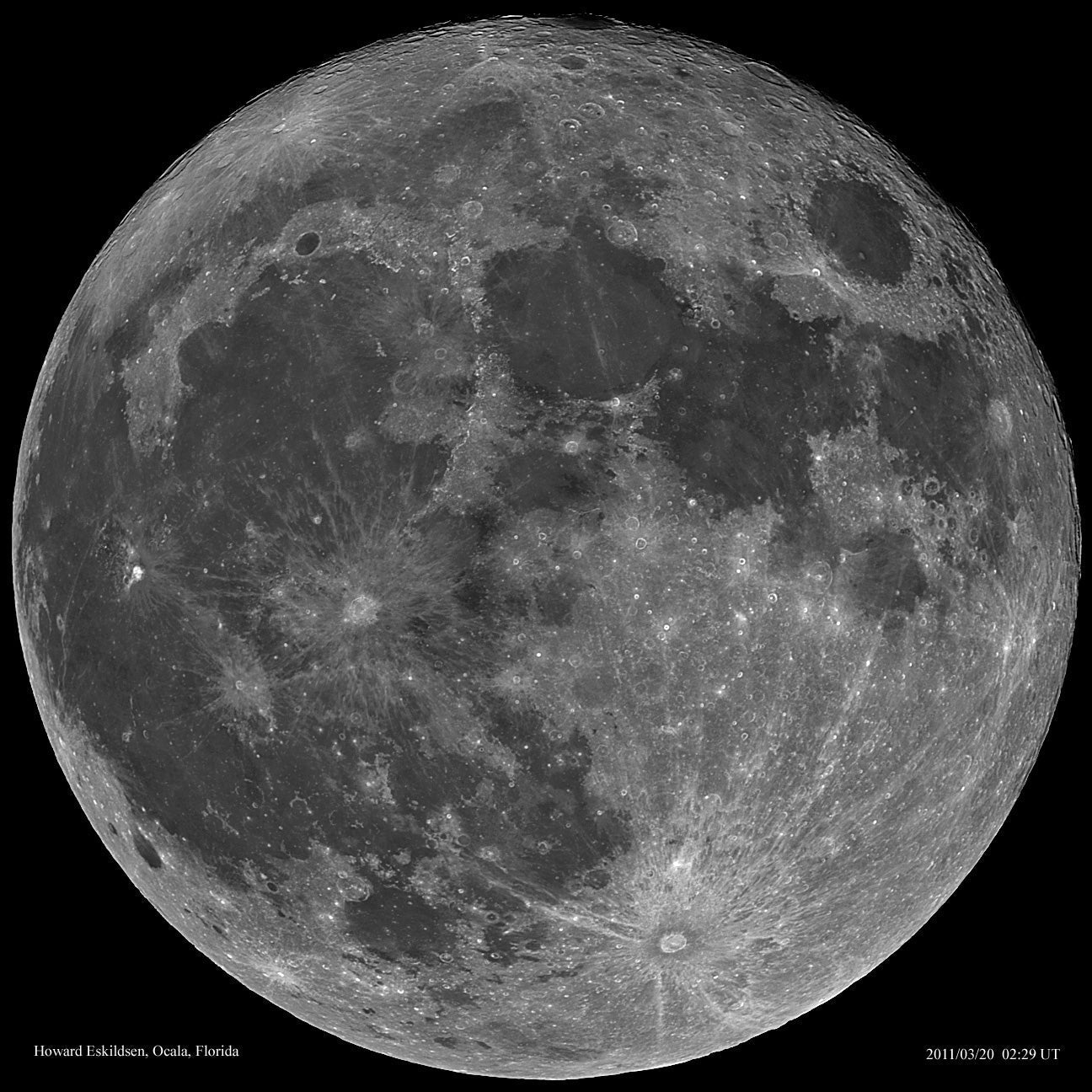
It’s a steady presence in all of our lives, but few people take the time to truly get to know Earth’s closest neighbor.
In this article, which was originally published as part of a series in Sky’s Up magazine, accomplished astronomer and astrophotographer Howard Eskildsen takes readers on a journey across the luminous face of the Full Moon.
Through images and words, Eskildsen explores the legions of geological formations that give the Moon its distinct personality. His in-depth information gives context to the features that pop to life when one views our oft-romanticized satellite through a telescope or other optical aid.
From its contribution to our tides to the artistic inspiration it provides, the Moon’s influence on Earth is profound, and it deserves a deeper look.

Region 28: Mountains, craters & plains!
Curious contrasts appear on this region of the moon. The Carpathian Mountains course diagonally across the lower margin of the image and yield to broad, flat plains known as Mare Imbrium. Other mountains rise above the plains near the left of the image, such as Mons Vinogradov and the unnamed peaks to the lower right of the Mons. Additionally, two isolated mountains rise from the plains on the upper right of the image: Mons La Hire, and the unnamed peak to the right of Lambert. Only a handful of craters more than 20 km in diameter mark the region, and even the small craters are few and far between.
Mountain building on the moon is almost always due to collisions of large objects — such as meteors, asteroids and comets — with the moon over the eons of its existence, so all the mountains on this image must be related to crater-forming impacts. Over all, the jagged edge of the Carpathian Mountains forms a bit of an arc, revealing that it is a remnant of a huge outer crater rim. Other views of the moon reveal that this rim surrounds Mare Imbrium and the center is north and east of this image. But it was no ordinary crater. It was so large it created multiple concentric rings and is known as an impact basin. Mons Vinogradov is likely related to the formation of this basin and Mons La Hire and the unnamed peak east of Lambert may be exposed portions of a mostly buried inner ring.

The colossal collision that excavated the basin also created deep cracks through the lunar exterior that provided conduits for molten material to flow up to the surface. Molten lava arose and spread across the terrain and covered most of the scars of the impact. Mountains, craters and large portions of the basin rings were overflowed by the lava. After hardening, the lava still appeared as if it were a great sea lapping against the remnants that managed to remain above its surface. Early observers imagined that it truly was a sea, hence they called such an area a “mare,” which is Latin for sea. Mare is pronounced “mahr’ ay” and its plural form is maria, pronounced “mahr-ee-uh.”
The lava, also known as mare basalts, flooded not only the impact basin, but other craters emplaced after the basin formed. The basalts also provided a smooth surface on which other craters later occurred. Lambert and Lambert R represent both extremes of the time scenario. Faint ridges encircle the “R” on the upper right of the image and reveal the presence of a buried crater that once resembled Lambert, just above it on the image. However, it was completely covered by the lava and only the barest wrinkles hint of its existence, hence only a shadowy reminder of its existence remains.
Other craters that nearly suffered the same fate include Gay-Lussac, Tobias Mayer and Natasha. Note their rings rising over lava that surround their rims and flood their floors. Three medium-sized craters — Euler, Pytheas and Lambert arrived after the lava stopped flowing.
On the majority of Mare Imbrium, tiny craters outnumber larger ones, and reflect the relative abundance of small versus large meteors striking the moon. However, not all of the impacting objects arrived directly from space. Irregularly shaped small craters by Draper, Pytheas and by the “Mare Imbrium” label are secondary impact craters from material ejected from the formation of Copernicus, south of this image. The powdery-white ray markings crossing the entire image came from Copernicus as well.
Even though this area of the moon has relatively few craters, much has gone over the eons of its existence, and many more questions arise about the processes and time involved.
-Images and text provided by Howard Eskildsen
(Originally published in Summer 2016 issue of Sky's Up E-Magazine)


Hinterlasse einen Kommentar
Alle Kommentare werden vor der Veröffentlichung geprüft.
Diese Website ist durch hCaptcha geschützt und es gelten die allgemeinen Geschäftsbedingungen und Datenschutzbestimmungen von hCaptcha.