




September 2025 Calendar
At any moment of the day, countless awe-inspiring celestial events are unfolding in the sky. With a universe of options, it can be hard to pin down what to observe. The purpose of this calendar is to provide a peek into what’s happening in the sky and in the world of astronomy in general and provide a quick list of highlights that can jump start your own explorations.

September 1 – Venus & the Beehive Cluster
If you’re looking for a great binocular target to kick off the month, be sure to turn your oculars to the sky in the pre-dawn hours of September 1 when the always-brilliant Venus visually pairs up with the beautiful Beehive Cluster. During this close encounter, the pair will be positioned just over 1 degree apart. The Beehive Cluster, which is also known as M44, lies about 560 light years away and can be observed with the naked eye. Located in the Cancer constellation, the cluster appears as a cloudy mass at first glance. But when you turn a pair of large aperture binoculars (10x50) or a small rich field telescope on it, its stellar inhabitants blaze to life. Covering more than 1.5 degrees of sky, the Beehive Cluster is home to at least 1,000 stars, with a large portion of those being red dwarfs and about 30 percent of a type similar to our Sun. It also includes some impressive blue-white beauties and a sprinkling of orange giants. Identified as a nebulous mass by the 2nd Century astronomer Ptolemy, M44 has a rich history that includes being one of the first objects studied through a telescope by famed astronomer Galileo, who realized it was actually a star cluster. It also has a strong foundation in the lore of ancient cultures. Also known as Praesepe, which means “manger” in Latin, the Greeks and Romans characterized the cluster as a manger that feeds two nearby stars, Asellus Australis and Asellus Borealis, which were seen to represent two famous donkeys that were key in a battle with the Titans.

Astrophotographer Steve Bellavia captured Titan's shadow transiting Saturn in the wee hours of July 18 with the aid of an Explore Scientific FirstLight Series 152mm Maksutov-Cassegrain.
September 4 / September 20 – Titan’s Shadow Transits Saturn (Observing/Imaging Challenge)
A transit season is under way for Saturn’s largest moon, but you’ll need perseverance and a sizable telescope to catch the show! Every 15 years, Earth and Saturn align in just the right way to reveal Titan’s shadow periodically gliding across the cloudy surface of the Ringed Planet. Thanks to a well-timed break in the clouds during a recent transit in the wee hours of July 18, astrophotographer Steve Bellavia was able to capture the above shot of Titan’s shadow as it raced across the face of Saturn. Although Titan's current transit series is almost done, this month offers two chances for astronomy enthusiasts to see an encore performance. These opportunities will start just after midnight on September 4 and September 20. The last chance will be October 6. After that, you will have to wait until 2040! Click here to check out our recent blog post on Steve’s quest to capture this rare sight.
September 7 – Total Lunar Eclipse
Viewers throughout Asia, Europe, Africa and Australia will be perfectly positioned to enjoy parts or all of a spectacular total lunar eclipse that is set to unfold over a period of 5 hours and 27 minutes on September 7. A total lunar eclipse occurs when a perfect alignment of the Sun, Earth and Moon causes the full moon to be shrouded by Earth’s shadow. During the event, the same phenomenon that gives our sunsets their beautiful, colorful glow will cast the Moon in some shade of burnt reddish orange. How red the Moon will appear depends on Earth‘s atmospheric conditions, such as dust levels and humidity, which affect the way sunlight is filtered and refracted to light the lunar surface. The total phase of the eclipse will last for 1 hours and 22 minutes, beginning at 17:30 UTC. The partial phase will last for two hours and 7 minutes, beginning at 16:27 UTC. For more information on the eclipse path, click here.

Astrophotographer Larry Byrge captured this image of the May 15, 2022, total lunar eclipse with the aid of an Explore Scientific ED102 Air-Spaced Triplet Refractor.
September 21 – Saturn at Opposition
Saturn and its dazzling rings will be in a prime viewing situation as the planet reaches opposition at 1 a.m. CDT on September 21. During this event, Saturn will be positioned directly opposite of the Sun when viewed from Earth. It will rise as the Sun sets and stay up all night, which means there will be ample observing and imaging time if seeing conditions are good. Saturn is currently tilted at a very slight angle that will make the rings very narrow when viewed through a telescope, but even then, they are a sight to behold. To find Saturn, look to the Pisces constellation. To the naked eye, it will appear as a steady, gold point of light. Following opposition, Saturn will remain a brilliant showpiece of the night sky for several months.
September 22 – September Equinox
A welcome sign of changing seasons for many, the September equinox is set to occur at 18:19 UTC on September 22. For those in the Northern Hemisphere, this event is a harbinger of autumn, while in the Southern Hemisphere, it heralds the arrival of spring. The September equinox occurs when the Sun passes from north to south across the celestial equator, which lies directly above its imaginary counterpart - Earth’s equator. No matter where you are located, on this date, the Sun rises due east and sets due west, and day and night are almost equal in length.
September 23 – Neptune at Opposition
The fact that Neptune was first found by mathematical prediction rather than actual observation reveals how elusive this planetary sibling can be. But by mid-September, amateur astronomers will be getting their telescopes ready for the planet’s move into a prime viewing position. At 13 UTC on September 23, the blue-hued Neptune will reach opposition, which means it will sit directly opposite of the Sun when viewed from our planet. Around the same time, it also will be making its closest passage to Earth. These circumstances translate to an excellent observing opportunity. Although it will have an apparent visual magnitude of 7.8, Neptune is not a naked eye object. To see it as more than a brilliant point of light, you will need to use at least a moderate-size telescope, which will hopefully render the planet as a steady blue disk and possibly provide a glimpse of its largest moon — Triton. To catch Neptune during opposition, look toward the Pisces constellation where it will be shining all night long.
CONSTELLATION SPOTLIGHT: Cygnus
Chockfull of astronomical treasures for observers of all levels, the Cygnus Constellation is a dominating force in the Northern Hemisphere sky this month. The elegant “Swan” occupies an 804-square-degree area of celestial real estate and is visible from 90° North to 40° South.
The quickest way to begin your exploration of Cygnus is to locate its popular asterism – the Northern Cross, which will lie overhead at midnight. Of the five standout stars that form the Northern Cross, the most prominent is Deneb (Alpha Cygni). With an apparent visual magnitude of 1.25 and an absolute magnitude of -8.38, this brilliant blue-white supergiant is easy to spot, extremely luminous and anchors one corner of the famed Summer Triangle. The other stars in the Northern Cross are Gamma Cygni, a yellow supergiant at the heart of the cross that is surrounded by a diffuse emission nebula; Delta Cygni, a triple star system that includes a close pairing of a blue-white giant and a yellow-white companion; Beta Cygni, a beautiful binary with contrasting blue and yellow-orange members that can be easily resolved; and Epsilon Cygni, an orange giant with an apparent visual magnitude of 2.48.
These are not the only notable star offerings in Cygnus. The constellation is also home to the binary system 61 Cygni, which is made of two orange dwarf stars. Also known as Bessel’s Star or the Flying Star, this intriguing double has impressive proper motion and was the first star other than our own to have its distance from Earth properly measured. Other observing options include Ruchba, a binary system with a red primary and a blue companion that pop in a telescope; P Cygnia, a rare luminous blue variable; and Chi Cygni, a long period pulsating red giant that varies in apparent magnitude from 3.3 to 14.2 over a period of 407 days.

Astrophotographers Donna and Donnie Houston captured this image of the Fireworks Galaxy with the aid of an Explore Scientific ED127 FCD100 Series Carbon Fiber Triplet Refractor.
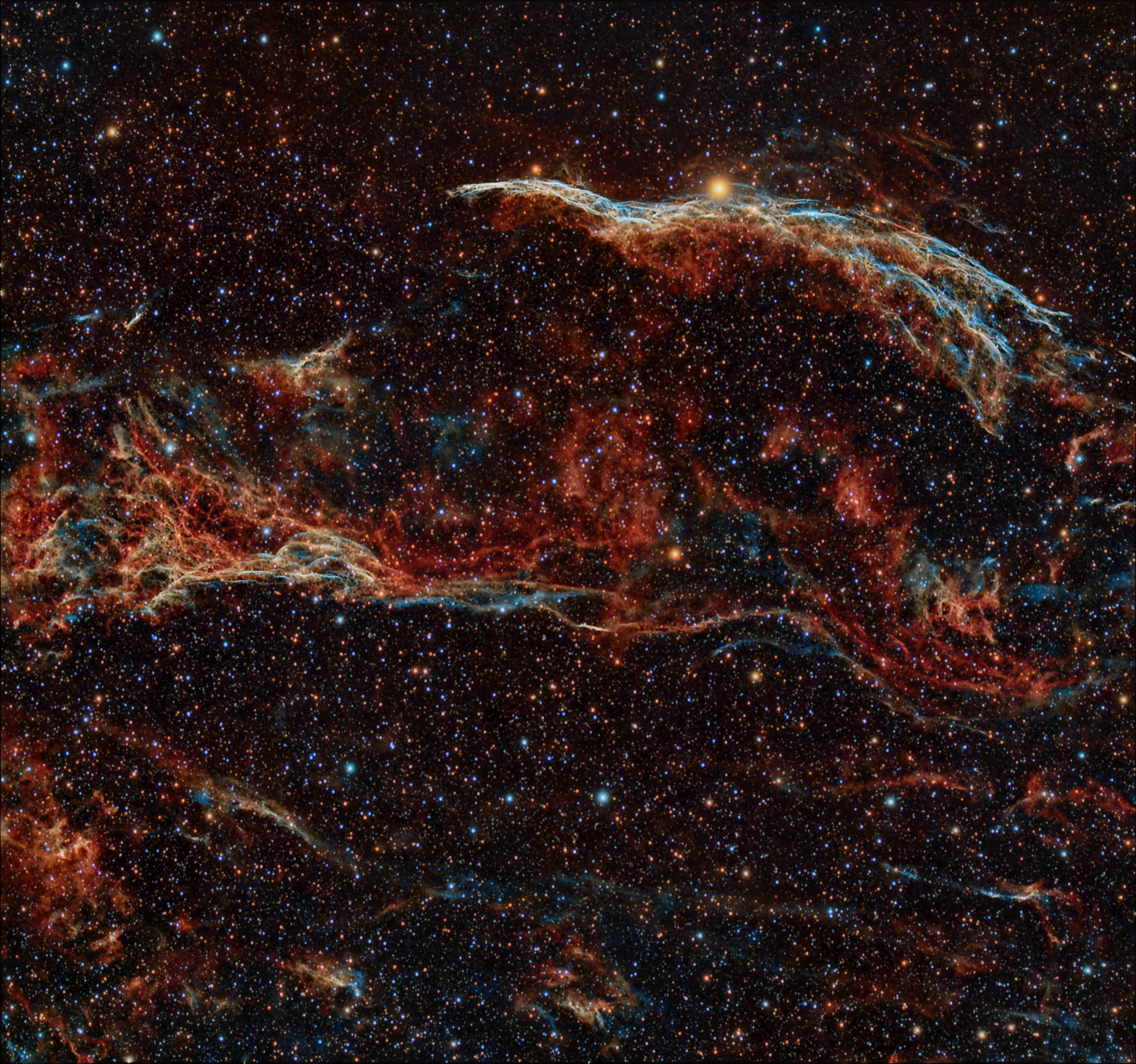
In addition to its stellar residents, Cygnus has a bounty of deep sky delights. Near Deneb, observers can find two worthy emission nebulae - the North American Nebula and the Pelican Nebula – separated by a dark lane. While the North American Nebula is larger, both have bright ridge-like features and reddish hues. Cygnus also hosts the Veil Nebula, which is a vast and complex supernova remnant that is divided into three main parts – the Eastern Veil, the Western Veil (aka Witch’s Broom Nebula) and Fleming’s Triangle. When viewed through a larger telescope, the nebula’s delicate details emerge. Other deep sky treats include the Crescent Nebula, an emission nebula that is courtesy of the stellar wind of a Wolf-Rayet star; the “Blinking Planetary” nebula that best reveals its central star when you use averted vision; the Fireworks Galaxy, an intermediate spiral that has been the site of more supernova sightings than any other galaxy; Messier 39, a rich open cluster with a triangle shape and an apparent magnitude of 5.5; and Messier 29, an open cluster near Gamma Cygni.
WANT TO NAVIGATE THE NIGHT SKY WITH EASE?

The Tirion Double-Sided Multi-Latitude Planisphere is a comprehensive sky map for northern hemisphere stargazers located between the equator and latitude 60° north that makes it easy to identify what constellations and major celestial objects are up in your night sky based on the date and time.
This night sky guide, which features maps crafted by noted celestial cartographer Wil Tirion, uses a double-sided design to minimize the distortion that is inherent to any polar-centered projection. This design choice means observers can see truer representations of the constellations located outside the equator (noted by a green line) by simply flipping the planisphere over.
In addition to showcasing constellations, this planisphere indicates the location of notable variable stars, open clusters, nebulae and galaxies. Other features include a line representing the ecliptic, a faint blue band for the Milky Way and a magnitude scale that indicates the brightness of the stars that are shown.
This astronomy planisphere is made of durable plastic that easily wipes clean, and the rotating components are secured with sturdy brass rivets for smooth manipulation. Guidance for using your sky map is printed on the device for quick reference.