


This week marks the 32nd anniversary of the dramatic collision between pieces of Comet Shoemaker-Levy 9 and our solar system’s largest planet, Jupiter. The comet was discovered on March 24, 1993, by the established comet-hunting team of Carolyn and Eugene Shoemaker and David Levy in a photo taken at the Palomar Observatory in California.
It quickly became clear that this comet deserved special attention as it was orbiting Jupiter instead of the Sun. Further analysis revealed that the now-fragmented comet had probably been orbiting Jupiter for decades intact. But in July 1992, it got too close, and Jupiter’s intense gravitational forces broke the icy body’s nucleus up into a string of pieces that were put on a collision course with the giant planet. Once the probability of a collision was clear, astronomers and scientists across the globe prepared for an unprecedented event – the first observed collision of two solar system bodies.
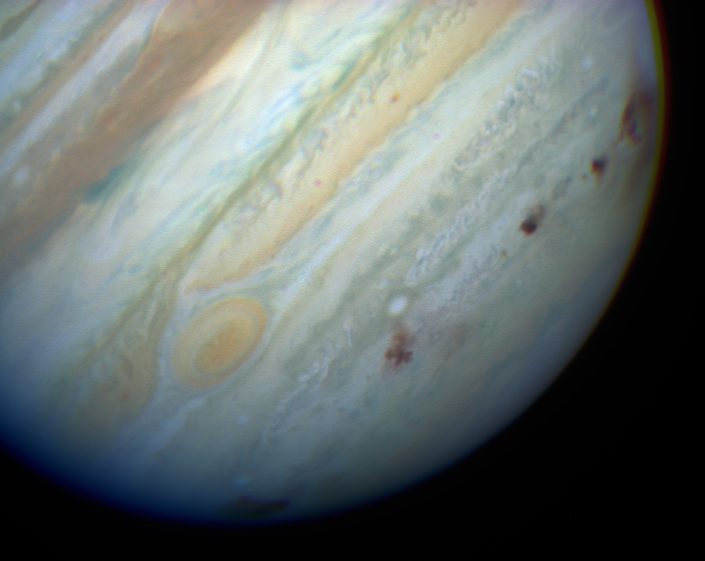
From July 16th to July 22nd, 1994, at least 21 separate fragments impacted Jupiter’s atmosphere and put on a stunning and revealing show for telescopes on Earth and in space. Conspicuous and impressive scars soon dotted the planet’s Southern Hemisphere. The largest chunk, identified as Fragment G, struck on July 18th and left a massive dark spot.
For some insight into this historic event, click the video from our archive below:
Image Credit: Hubble Space Telescope Comet Team / NASA
This image of Jupiter was taken with NASA's Hubble Space Telescope's Planetary Camera in July 1994. Eight impact sights are visible. From left to right are the E/F complex (barely visible on the edge of the planet), the star shaped H site, the impact sites for tiny N, Q1, small Q2, and R, and on the far right limb the D/G complex. The D/G complex also shows extended haze at the edge of the planet. The features are rapidly evolving on timescales of days. The smallest features in this image are less than 200 kilometers across.

发表评论
所有评论在发布前都会经过审核。
此站点受 hCaptcha 保护,并且 hCaptcha 隐私政策和服务条款适用。