




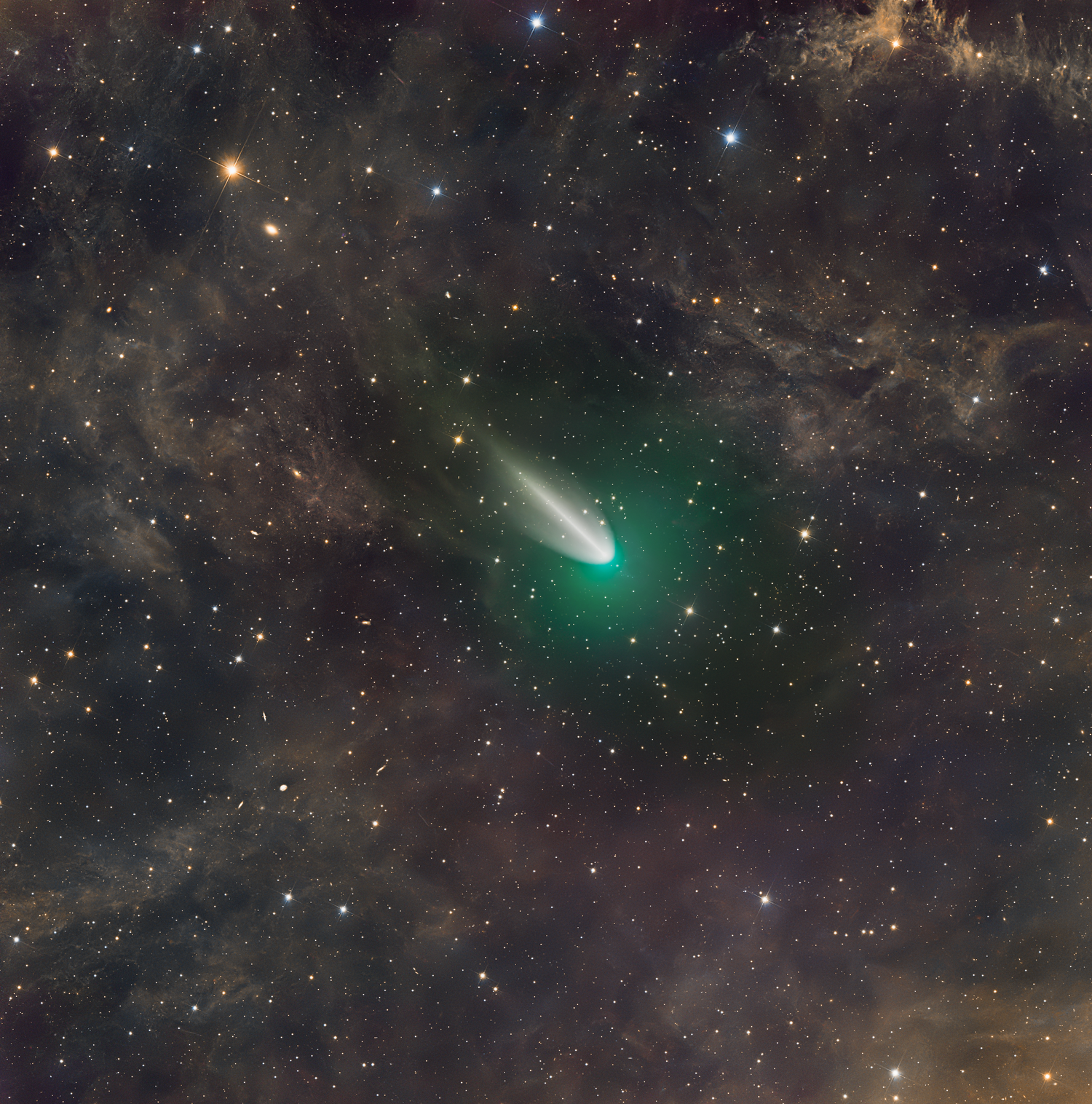
A small comet is moving through our solar system, carrying with it a reminder far larger than itself: the universe has not finished surprising us.
Its name is 220P/McNaught.
Under ordinary circumstances, most people would never hear about it. Discovered by astronomer Robert H. McNaught in 2004, 220P is a periodic comet that completes an orbit around the Sun in about 5.5 years. It spends its journey between the regions of Mars and Jupiter and is normally so faint that finding it requires a telescope, a sensitive camera, and an accurate ephemeris telling you precisely where to look.
But in 2026, 220P/McNaught refused to behave ordinarily.
On May 26, astronomers measured the comet at about magnitude 17.4 in red light—far beyond the reach of binoculars and most amateur telescopes. Sometime between May 30 and the early hours of May 31, it erupted.
Images from the Zwicky Transient Facility showed the comet brightening by more than six magnitudes within days. Material released from its nucleus expanded into a nearly symmetrical cloud tens of thousands of kilometers across. Follow-up spectroscopy detected CN, C₂, and C₃ gas in the ejecta. This was not simply a point of light becoming brighter. The comet had suddenly released a substantial mixture of gas and dust into space. (The Astronomer’s Telegram #17829)
Then, after fading, it did it again.
A second strong outburst occurred in early August. By August 8, professional observations showed the comet surrounded by a coma extending at least 300,000 kilometers. Visual observers subsequently reported it near magnitude 7.6 to 8.3—bright enough to become a compelling target in binoculars and small telescopes under a good sky. As late as August 22, observers were still recording a distinct coma and short tail, although the comet had faded to around magnitude 10 and continued to change from night to night. (The Astronomer’s Telegram #17956, Vereinigung der Sternfreunde observing reports)
NASA’s Astronomy Picture of the Day for August 24 described the two outbursts as making 220P about 20,000 times brighter than usual. That is a dramatic—and useful—way of describing the scale of its transformation, but comet magnitudes must be compared carefully. The result depends on the filter, observing aperture, date, and whether the measurement includes the compact central region or the entire diffuse coma.
The consistently measured May observations document a rise of more than six magnitudes. Broader comparisons between the normally faint comet and its brightest reported post-outburst appearance can produce the much larger 20,000-fold figure. The precise multiplier is therefore measurement-dependent. The central fact is not in doubt: 220P underwent two exceptional and independently observed increases in activity. (NASA Astronomy Picture of the Day)
Think about that for a moment.
A comet that had been moving quietly through the darkness suddenly became hundreds, thousands, or—by the broadest comparison—roughly twenty thousand times brighter. Material that had been locked inside or beneath its surface was released into sunlight, creating a luminous cloud vastly larger than Earth.
And we do not yet know precisely why.
Scientists understand several physical processes capable of producing cometary outbursts. Sunlight can warm volatile ice beneath an insulating crust until accumulating gas fractures the surface. A cliff or weakened section of the nucleus can collapse and expose fresh ice. Changes in the structure of the nucleus can open vents or release pockets of trapped gas. The crystallization of amorphous water ice may also release heat and gases trapped within it.
These are credible mechanisms supported by observations of comets in general. They are not yet a confirmed diagnosis for 220P. The popular phrase “comet quake” provides an evocative mental picture, but it is an informal description rather than an established explanation. We know that 220P released gas and dust. We do not yet know exactly what triggered either eruption—or whether the two outbursts had the same cause.
That distinction matters to me. Wonder does not require exaggeration. In fact, wonder becomes more powerful when we are honest about the boundary between what we know and what we are still trying to understand.
Images of 220P have revealed a beautiful greenish-blue coma. This color is consistent with emission from molecular carbon, C₂, energized by sunlight—a familiar source of the green glow seen in many active comets. Spectra obtained after the first eruption directly detected C₂, and August observations again associated the colored outer coma with molecular-carbon emission.
At the same time, color and polarization measurements indicate that sunlight scattering from dust made a major contribution to the coma and tails. What we are seeing is not simply a green ball of gas. It is an evolving mixture of gas and dust, with each component responding differently to sunlight, radiation pressure, and the solar wind. (The Astronomer’s Telegram #17829, The Astronomer’s Telegram #17984)
What I find especially beautiful about this story is that it does not belong only to large professional observatories.
Automated surveys discovered and measured the outbursts. Researchers used spectroscopy, photometry, and polarimetry to study the newly released material. But amateur astronomers around the world also followed 220P with binoculars, backyard telescopes, cameras, and increasingly capable automated instruments. They photographed its movement, estimated its brightness, sketched its coma, and watched its tail change from one morning to the next.
Professional and amateur astronomers were sharing one sky.
There are few sciences in which this remains so literally true. A major observatory can measure the chemistry of a comet while, on the same night, someone standing outside a home can raise a pair of binoculars and observe the same object. The equipment may differ. The questions may differ. But the light entering every instrument began its journey at the same small, active world.
At Explore Scientific, this connection between people and the sky is at the heart of what we do. A comet like 220P offers several ways to participate, depending on whether your passion is visual observing or imaging.
For an immersive visual experience, the Explore Scientific BT-150 ED Super Giant Binoculars are extraordinary comet instruments. Their twin 150mm objectives collect an enormous amount of light, while interchangeable 1.25-inch eyepieces allow the observer to adapt magnification and field of view as a comet evolves. With the included eyepieces, they operate at approximately 28 power—an excellent range for studying a bright coma in the context of the surrounding star field.
These are serious observatory-class binoculars, weighing a little over 41 pounds without their eyepieces or case, so they require the dedicated U-mount and tripod. But when properly mounted under a dark sky, viewing with both eyes can make the experience remarkably dimensional and immediate. You are not merely locating the comet. You feel as though you are encountering it.
Observers wanting a more portable binocular telescope can consider Explore Scientific’s smaller BT models. Whatever the aperture, the essential requirement is stability. A firmly mounted binocular reveals far more than an instrument trembling in your hands.
For astrophotographers, I would look toward an Explore Scientific FCD100 air-spaced triplet refractor. The compact ED80-FCD100 is especially well suited to wide-field comet imaging. Its 80mm aperture, 480mm focal length, and f/6 focal ratio offer a useful balance of portability, field of view, and optical correction. With the available 0.8× reducer, it becomes a 384mm, f/4.8 imaging system—wide and fast enough to record a comet’s coma, tail, and movement against the stars.
The ED102-FCD100, with its 102mm aperture and 714mm focal length, provides more image scale while remaining manageable for field use. Both telescopes use HOYA FCD100 extra-low-dispersion glass in air-spaced triplet objectives, helping control chromatic aberration and preserve tight, natural-looking stars around the comet.
A properly tracking equatorial mount is just as important as the telescope. Because a comet moves against the background stars, astrophotographers must decide whether to track the stars, track the comet, or combine separately processed exposures. Long star-tracked images can leave the comet blurred; comet-tracked images can turn stars into trails. This is part of the beauty and challenge of comet photography: the image itself records that the solar system is in motion.
As of August 24, 220P/McNaught remains scientifically important and observable, but it is fading. NASA notes that it will pass at roughly one astronomical unit from Earth in October—not a close or dangerous encounter—and is expected to dim quickly as it recedes toward the outer portion of its orbit.
Anyone attempting to find it should use a current ephemeris rather than a position printed days or weeks earlier. Comets move noticeably against the stars, and their brightness is especially difficult to predict following an outburst. Continued imaging, spectroscopy, sketches, and brightness estimates remain valuable precisely because the comet is still changing.
This is why I resist the idea that astronomy is a finished map of familiar things.
We have telescopes capable of looking back toward the first galaxies. We have spacecraft orbiting other worlds, laboratories measuring the chemistry of distant atmospheres, and computers predicting celestial motion with extraordinary precision. Yet a small comet only a few kilometers across can still wake without warning and send astronomers around the world scrambling toward their instruments.
Discovery is not something that happened only in the age of Galileo, Herschel, or Hubble. It is happening now—sometimes in an automated survey image, sometimes through a giant binocular telescope, sometimes in a carefully processed photograph, and sometimes in the simple act of looking up and realizing that the sky has changed.
That realization can change us as well.
Awe does not make our earthly problems disappear. It does something subtler and perhaps more useful: it restores proportion. It reminds us that the universe is larger than our arguments, older than our fears, and more creative than our expectations. It teaches humility without demanding despair.
We are small, yes. But we are also the part of nature capable of noticing, measuring, questioning, and being astonished.
220P/McNaught will fade. It will move outward again, returning to the darkness from which it briefly emerged. Astronomers will continue analyzing what happened, and perhaps one day we will understand the sequence completely.
For now, the comet has given us something equally valuable: evidence that the familiar can become extraordinary without warning, that unanswered questions still travel through our celestial neighborhood, and that the universe remains alive with possibilities we have not yet imagined.
At Explore Scientific, we build instruments to help people meet that universe for themselves. But the journey always begins before the telescope, before the camera, and before the first recorded image.
Always keep exploring.
• • •
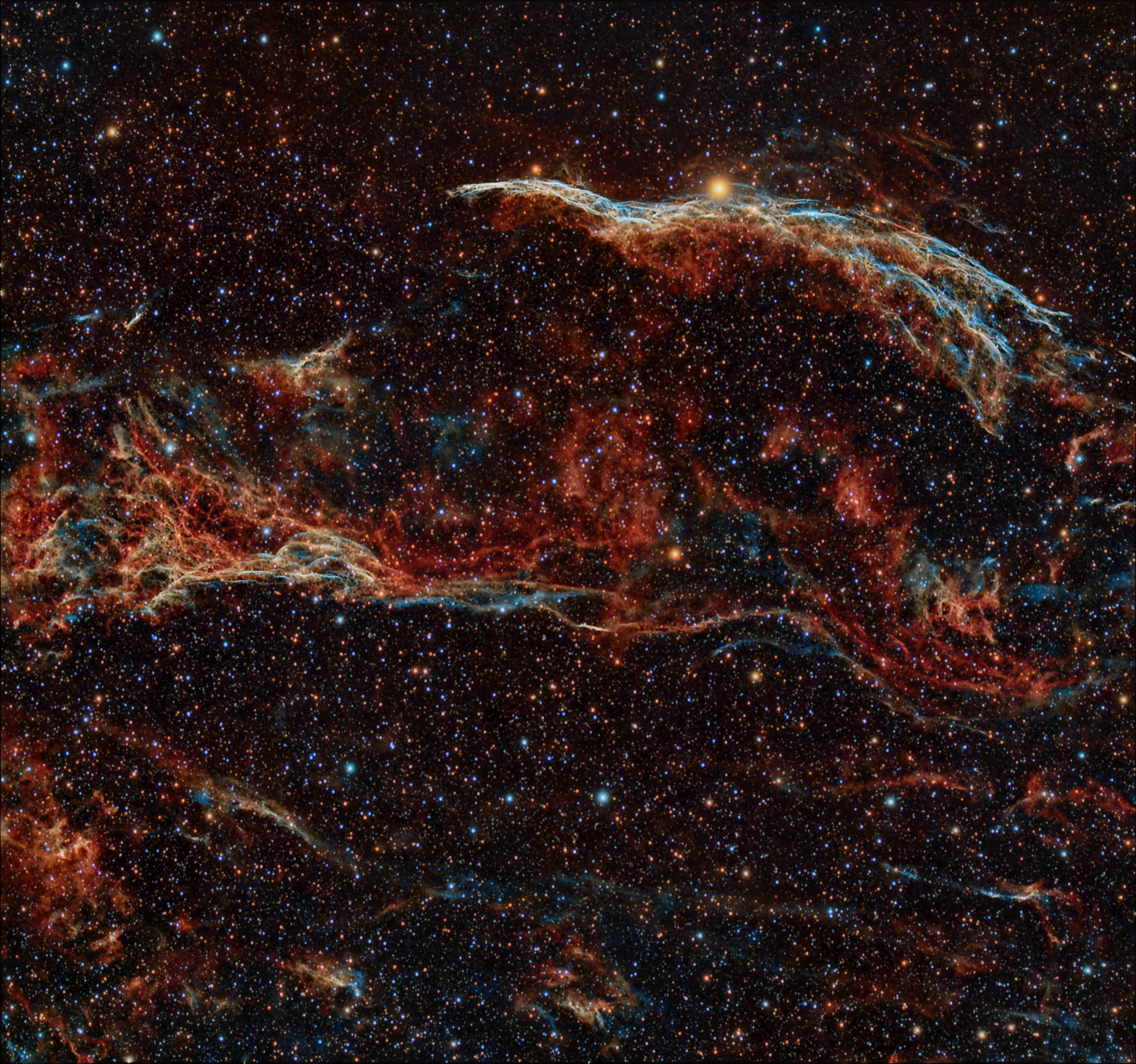
Image credit: Chuck Ayoub, CC0, via Wikimedia Commons

发表评论
所有评论在发布前都会经过审核。
此站点受 hCaptcha 保护,并且 hCaptcha 隐私政策和服务条款适用。