


October 2026 Calendar
At any moment of the day, countless awe-inspiring celestial events are unfolding in the sky. With a universe of options, it can be hard to pin down what to observe. The purpose of this calendar is to provide a peek into what’s happening in the sky and in the world of astronomy in general and provide a quick list of highlights that can jump start your own explorations.

Oct. 4-10 - World Space Week
Designed to inspire, enlighten and promote, World Space Week is an annual global celebration of space, science and technology coordinated by the United Nations and the World Space Week Association. Using the theme “Rocket Revolution,” this year’s international event is on track to be huge, with tens of thousands of events already scheduled all around the planet. Launched by a declaration of the U.N. General Assembly in 1999, World Space Week begins every year on October 4th to recognize the anniversary of the 1957 launch of Sputnik 1, the first man-made Earth satellite. It wraps up on October 10th in commemoration of the signing of a 1967 treaty that provided the basic framework of international space law. For information on the events scheduled throughout the world to celebrate the week, visit www.worldspaceweek.org.

Astrophotographer Steve Bellavia captured this image of Saturn's moon Titan transiting the face of the planet in 2025 with the aid of an Explore Scientific FirstLIght 152mm Maksutov-Cassegrain.
ALL MONTH: Check out Saturn!
Saturn began October at opposition, which means it and its dazzling rings will be in a prime viewing situation throughout October. During opposition on October 4, Saturn was positioned directly opposite of the Sun when viewed from Earth – meaning it rose as the Sun set and stayed up all night. Saturn is currently tilted at a very slight angle that will make the rings appear nearly edge-on. But even when they are only slightly tilted, the rings are still a sight to behold when viewed through a telescope. To the naked eye, it will appear as a steady, gold point of light.
October 6 - Moon and Jupiter Conjunction (AND Occultation for Some)
The waning crescent Moon and the giant planet Jupiter will get very close visually in the pre-dawn sky on October 6 in the Leo constellation. AND observers in parts of the United States, Canada, Mexico, the Caribbean and Africa will even be positioned beneath a lunar occultation of Jupiter – where the Moon will move in front of the planet. With the naked eye, Jupiter will manifest as a bright point of light, but a modest telescope may reveal the giant planet’s impressive cloud belts, its turbulent Great Red Spot or any of the four Galilean moons. This is also a good opportunity, if you have some extra observing time, to peek at Mars and the Beehive Cluster, which will be in the neighborhood.
October 8-9 – Draconid Meteor Shower Peaks
While it usually does not result in an impressive number of meteors per hour, the Draconid event is a notable rarity among meteor showers because these meteors are best seen in the early evening instead of in the more common post-midnight hours. This meteor shower’s radiant point is in the head of the Draco the Dragon constellation, which makes it mostly a northern hemisphere phenomenon. Set to peak on Oct. 8-9, the shower usually only produces a few meteors per hour, but it is unpredictable and has produced hundreds per hour in some years. There is no indication that this year’s event will generate an unusual bounty of meteors, but the nearly-new Moon will not present any interference, which makes for ideal observation conditions. For prime viewing find a position under a dark open sky away from light pollution, lie down, look up and enjoy the show.
October 11 – Mars visits the Beehive
In the pre-dawn sky on October 11, the Red Planet will visually pair up with the beautiful Beehive Cluster. During this close encounter, the pair will pass within 4.8 arcminutes in the Cancer constellation. The Beehive Cluster, which is also known as M44, lies about 560 light years away and can be observed with the naked eye. The cluster appears as a cloudy mass at first glance. But when you turn a pair of large aperture binoculars or a small rich field telescope on it, its stellar inhabitants blaze to life. Covering more than 1.5 degrees of sky, the Beehive Cluster is home to at least 1,000 stars, with a large portion of those being red dwarfs and about 30 percent of a type similar to our Sun. It also includes some impressive blue-white beauties and a sprinkling of orange giants. Identified as a nebulous mass by the 2nd Century astronomer Ptolemy, M44 has a rich history that includes being one of the first objects studied through a telescope by famed astronomer Galileo, who realized it was actually a star cluster. It also has a strong foundation in the lore of ancient cultures. Also known as Praesepe, which means “manger” in Latin, the Greeks and Romans characterized the cluster as a manger that feeds two nearby stars, Asellus Australis and Asellus Borealis, which were seen to represent two famous donkeys that were key in a battle with the Titans.
October 12 – Mercury at Greatest Elongation East
Around October 12, Mercury will be in a good position for early evening viewing, especially in the southern hemisphere. Because it is always so close to the Sun, Mercury is usually lost in its glare. But on October 12 it will be at its greatest eastern elongation or at its furthest point to the east of the Sun, which puts it in an uncommon observation situation. A clear western horizon is essential for viewing Mercury, which can be found in the Libra constellation during the event and will appear close to Venus. While Mercury will be visible to the naked eye, a small telescope could provide some phase details.
October 21 – Orionid Meteor Shower Peaks
This year the peak of the annual Orionid meteor shower coincides with a waxing gibbous Moon, which will be a bit of a hindrance to observers who prefer to stay up late to meteor hunt. But, the Moon will set in the wee hours, leaving early risers a great viewing opportunity for at least a couple of pre-dawn hours. Generated when the Earth crosses paths with the dust left behind by Halley’s Comet, the Orionids radiate from the constellation Orion and generally last for about a week in late-October. Observers can typically see 10-25 meteors per hour during the shower‘s peak activity time, which will occur between midnight and dawn around October 21st. Although the Orionids move fast, they have been known to leave a glowing gas trail that lasts for a few stunning seconds. For prime viewing find a position under a dark open sky away from light pollution, lie down, look up and enjoy the show.
October 27 – Close approach of Moon and M45
The waning gibbous Moon and the storied Pleiades star cluster with its brilliant blue stars will appear just about 58 arcminutes apart on October 27 – meaning it’s a great time to see the duo in a pair of binoculars. Also know by the names Messier 45 or the more poetic Seven Sisters, the Pleiades open star cluster has a rich lore that crosses cultures and goes back thousands of years. It is relatively young, having formed within the last 100 million years, and lies relatively close to Earth at about 440 light years away. Found in the Taurus constellation, it consists of more than 1,000 confirmed stars, although an average of only six are visible to the naked eye. A dark sky free of light pollution can help a dedicated observer see around a dozen Pleiades stars, but a good pair of binoculars or a low-power telescope can quickly reveal the more elusive members of this legendary cluster.
ALL MONTH: Andromeda Galaxy
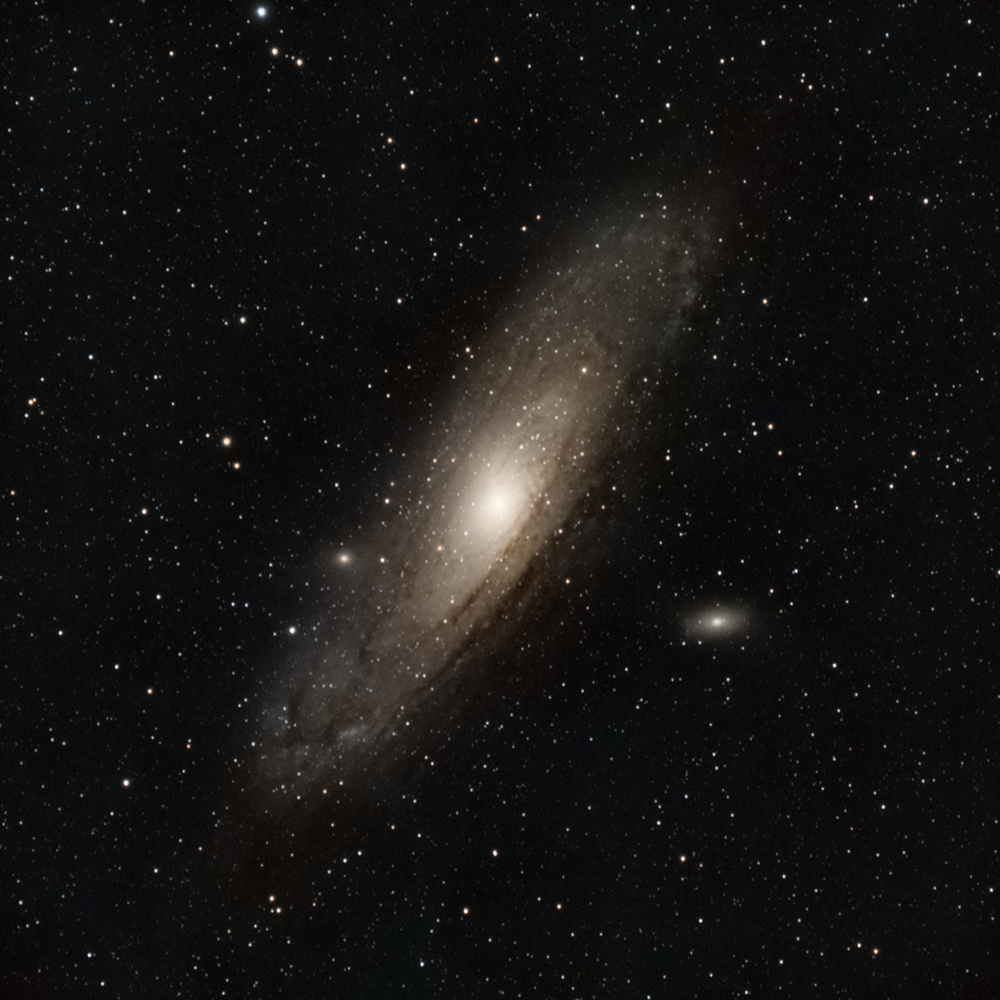
Autumn’s dark skies make a perfect stage for amateur astronomers to view the beauty of the bright Andromeda Galaxy, which currently sits high in the sky from dusk to dawn. Located at about 2.5 million light years away from Earth, the Andromeda Galaxy is the closest major galaxy to our own Milky Way. Although it is the most distant object the naked eye can see, binoculars can be a handy aid for locating the galaxy, and a telescope will reveal its spiral details and its much smaller companion galaxies known as M32 and M110. To locate the galaxy, find the Great Square and look for two streams of stars that shoot off of it into the Andromeda constellation. An imaginary line drawn up from the middle star of the bottom stream to the middle star in the upper stream, will point to Andromeda.

Astrophotographer Craig Bobchin captured this image of the Andromeda Galaxy with the aid of an Explore Scientific iEXOS-100 GoTo Tracker Mount.
CONSTELLATION SPOTLIGHT: Pegasus
Now is an ideal time for observers from 90° North to 60° South to peruse the Pegasus Constellation as it grandly soars across the night sky like the Winged Horse it represents. At 1,121 square degrees, Pegasus is the 7th largest constellation. One of its most prominent features is the Great Square of Pegasus asterism that forms the body of the mythological beast. The four stars that define this popular autumnal asterism are Pegasus’ Markab, Scheat and Algenib and Andromeda’s Alpheratz, which anchors the northeastern corner. In the northwestern corner, observers will find the red star Scheat (Beta Pegasi), which is an irregular variable that is transitioning into a giant. Markab (Alpha Pegasi), which sits in the southwestern corner of the square, is a class B dwarf star with an apparent magnitude of 2.48, and Algenib (Gamma Pegasi) is a nice variable blue star that marks the southeastern point of the Great Square. Although these are the easiest to find of Pegasus’ stars, there are many other stellar treats within the horse’s domain. Just outside the Great Square lies 51 Pegasi. Visible in binoculars, this yellow beauty is similar to our own star and has the distinction of being the first Sun-like star to have a planet discovered in its orbit. Other star targets include Enif (Epsilon Pegasi), a brilliant orange supergiant that will show a reddish hue in binoculars; Eta Pegasi, a binary system with an apparent magnitude of 2.95; Zeta Pegasi, a class B dwarf that exhibits slight shifts in luminosity; IK Pegasi, a binary star that pairs a class A main sequence with a massive white dwarf companion; and Mu Pegasi, a yellow giant with an apparent magnitude of 3.514. In terms of deep sky offerings, one of Pegasus’ standouts is Messier 15. In addition to offering a host of variable stars and pulsars, this globular star cluster is home to Pease 1 – a famed planetary nebula that was the first its kind to be discovered within a globular cluster and remains a rarity. Although the dense cluster lends itself to exploration, you will need a large aperture scope if you hope to see Pease 1. For galaxy hunters, Pegasus also offers NGC 7814, the edge-on spiral that is 6.3 arc minutes in diameter and sometimes called the Little Sombrero because it resembles Virgo’s Sombrero Galaxy; NGC 1, a spiral galaxy that was the first deep sky object entered into the New General Catalogue; NGC 7217, a spiral with a 3.7 arc minute diameter and a tight swirling structure; NGC 7742, a face-on unbarred spiral; and NGC 7331, a tilted spiral that resolves into a bright core, wispy arms and nebulous areas in large aperture scopes.


Image Credit: ESA/Hubble & NASA / Acknowledgement: Josh Barrington
The Pegasus constellation is home to NGC 7814, an edge-on spiral that is sometimes called the Little Sombrero because it resembles Virgo’s Sombrero Galaxy.
Want to navigate the night sky with ease?

The Tirion Double-Sided Planisphere is a comprehensive sky map for northern hemisphere stargazers located between the equator and latitude 60° north that makes it easy to identify what constellations and major celestial objects are up in your night sky based on the date and time.
This night sky guide, which features maps crafted by noted celestial cartographer Wil Tirion, uses a double-sided design to minimize the distortion that is inherent to any polar-centered projection. This design choice means observers can see truer representations of the constellations located outside the equator (noted by a green line) by simply flipping the planisphere over.
In addition to showcasing constellations, this planisphere indicates the location of notable variable stars, open clusters, nebulae and galaxies. Other features include a line representing the ecliptic, a faint blue band for the Milky Way and a magnitude scale that indicates the brightness of the stars that are shown.
This astronomy planisphere is made of durable plastic that easily wipes clean, and the rotating components are secured with sturdy brass rivets for smooth manipulation. Guidance for using your sky map is printed on the device for quick reference.