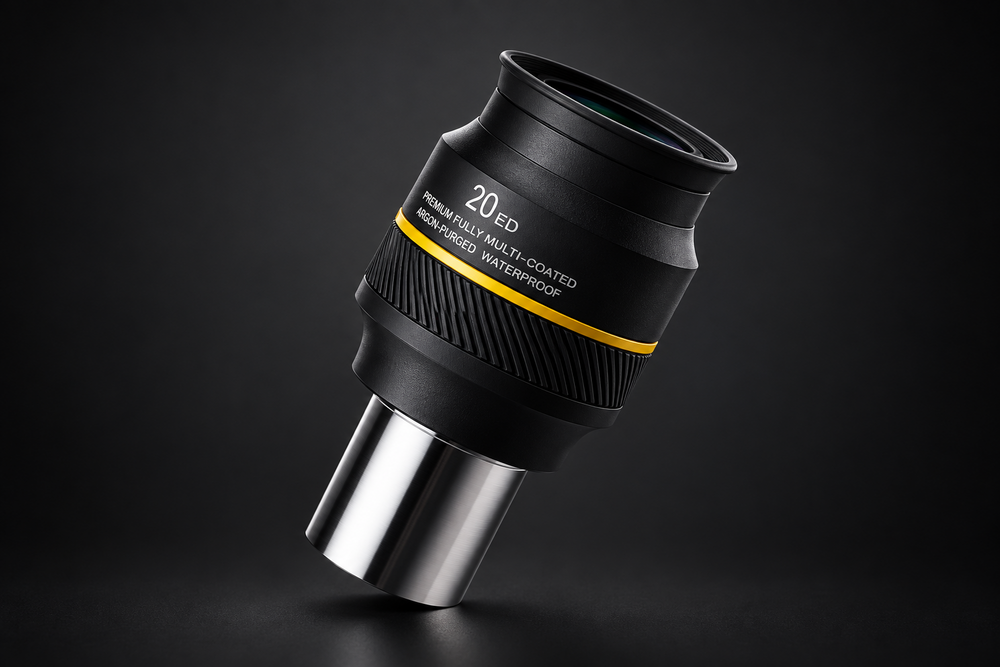
I've enjoyed these binoviewers for about six months now. At first it was recommended to get the 20mm eyepieces for them but later also purchased a set of 30mm eyepieces and there is a significant difference, which I will explain.
Unlike other binoviewers, these do not require additional attachments to achieve focus. These are parfocal, meaning - just plug and play. Kent has an excellent video online to explain how to properly set them up for use, so I won't go into that.
Here's my opinion on them after comparing them to another popular brand of binoviewers.
The other binoviewers I had used were very good, clear images without any vignetting, good color, good all around performance. But the drawback to them was several things. Needed another lens to achieve parfocal focus. Each eyepiece was not able to be individually focused leading to problems with my eyesight because I have two different prescription lenses for my eyeglasses. Another thing I did not like is the pupil distance adjustment. They are like a pair of binoculars, pivoting in the middle. I did not have a problem with this except that it was hard to adjust the distance again with my presbyopia that I couldn't get a good focus / image through them. Using just one eye, with the other closed, the image was crisp, proper color image. But using one eye is not what these were intended for.
On to the Explore Scientific binoviewer.
Nice crisp, clear image, no vignetting, proper color and easy to use. No additional lens to achieve focus. These use a slide type mechanism to adjust pupil distance. This made it easier for me to get focus, see clearly with no "double" image in the field of view.
The other binoviewer did not have a focus adjustment on either the right or left eyepiece. The E.S. Binoviewer does. Use your left eye to get the image in focus. Then with the right eyepiece you can adjust the focus for your vision. This will give you a crisp, clear image of what you are looking at.
These binoviewers are much similar to the Orion binoviewers - but Orion is no longer in business.
Drawbacks: Well not many. My OCD/ADD/ADHD and other alphabet disorders would prefer to have these in black instead of white. Just to go with my equipment. If the case that came with these were a little bigger it would be able to hold a couple of pairs of eyepieces and make the combination "more efficient."
Pluses: No additional hardware to make the binoviewer work with your telescope system. Will accept all kinds of 1.25 inch eyepieces. Online videos make these viewers easy to use - just about plug and play. I've got some 20mm and 30mm eyepieces and with the 20mm you can see detail. The 30mm will show a slightly larger field of view to give you more perspective of the sky you're observing.
These binoviewers are a great value for the price point. Easy to use. No additional equipment or accessories needed (aside from eyepieces.) Great support from Explore Scientific.