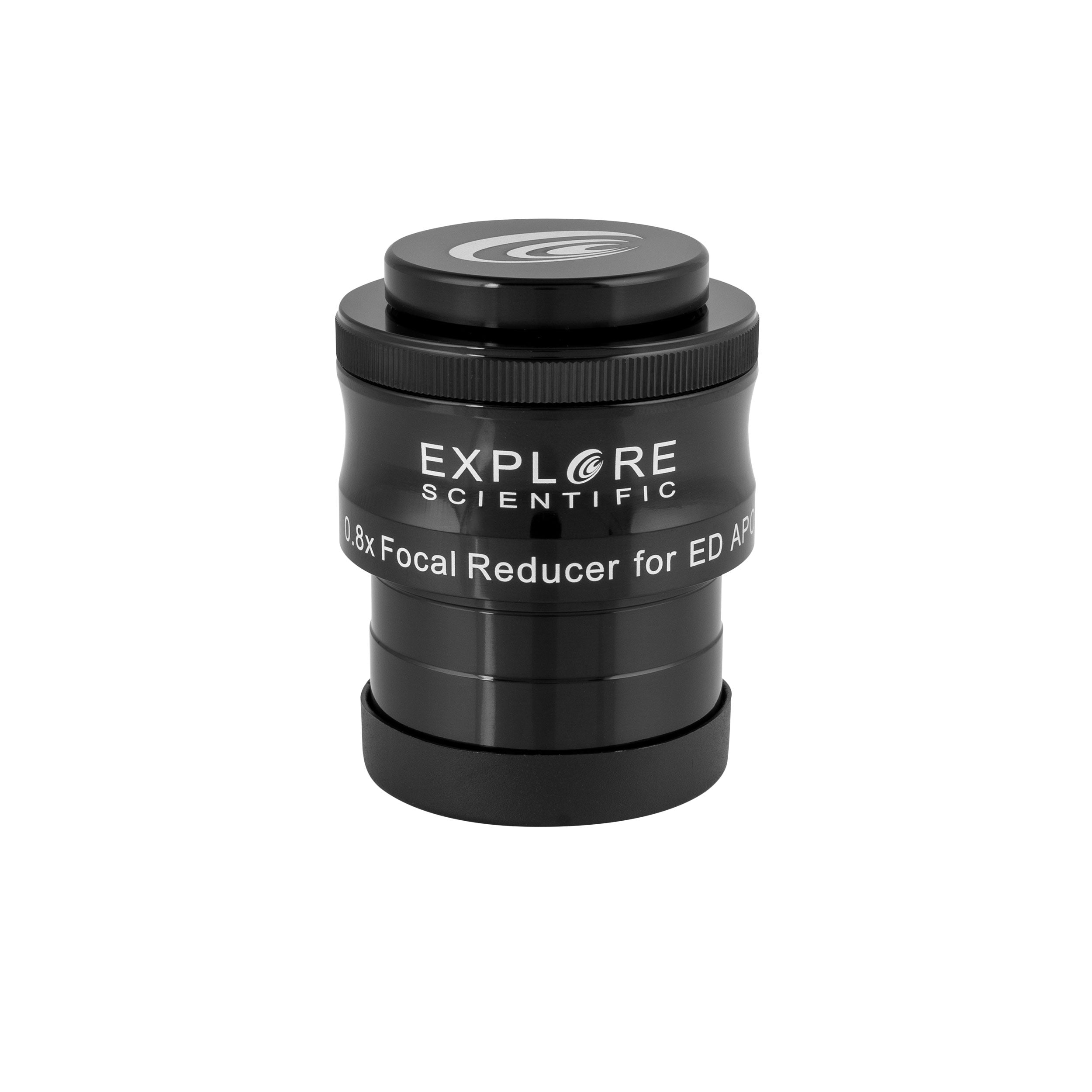
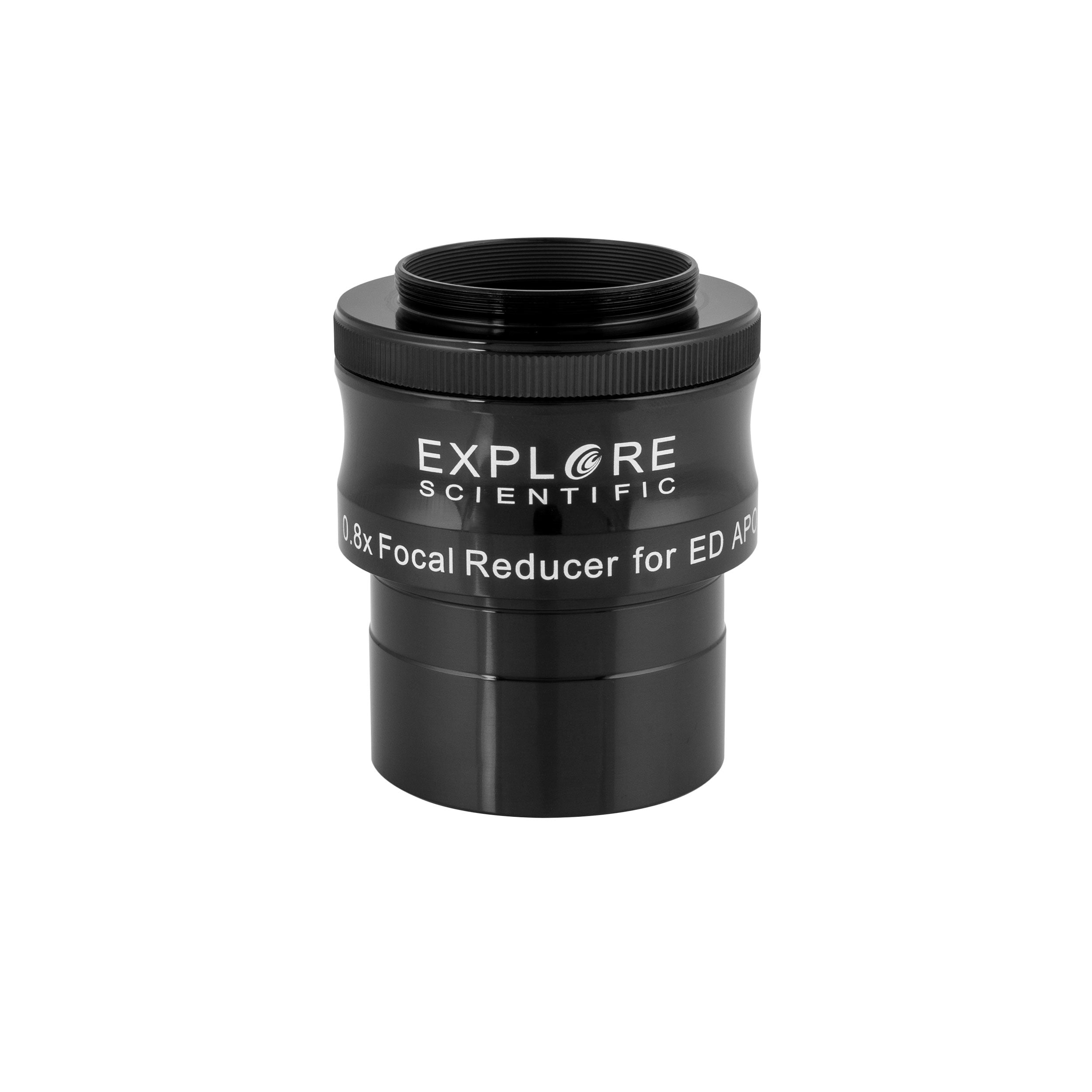


0.8x Focal Reducer
The Explore Scientific 0.8x Focal Reducer lets astrophotographers explore the wonders of wide-field astrophotography in an easy-to-use package.
The 0.8x Focal Reducer works with the following Explore Scientific telescopes:
The 2-element 0.8x focal reducer turns the 480-mm-focal-length telescopes into devices with a focal length of 384 mm. This changes the telescopes from an f/ratio of f/6 to a much faster f/4.8. The device turns the 102 mm telescopes, with a focal length of 714 mm, into telescopes with a focal length of 571 mm: From f/7 to f/5.6. Compare this with smaller diameter wide-field telescopes. The Explore Scientific ES and FCD100 80mm telescopes offer significantly more light-gathering aperture. The ES and FCD100 telescopes gather:
- 1.3 times more light than a 70 mm telescope
- 1.8 times more light than a 60 mm telescope
- A whopping 2.6 times more light than a 50 mm telescope
The faster f/ratio, coupled with more light-gathering aperture, allows more light to fall onto the camera sensor. For instance, to capture the same amount of light as a 100-second exposure with the Explore Scientific 80 mm takes 256 seconds on a 50 mm, 178 seconds on a 60 mm, and 131 sec on 70 mm – assuming the same f/ratio. This means that the Explore Scientific 80mm telescope with the 0.8x Focal Reducer can capture far more detail faster than the competition. The focal reducer, which has 55 mm (+/- 2 mm) of back spacing, is threaded to accept a standard 42 mm T-ring, making attaching a camera easy.
I bought this to use with a Svbony SV550 80mm, since there isn't a focal reducer designed specifically for this telescope. Because all the specifications are practically the same as the Explore Scientific ED80 Essential Series Triplet Refractor, I decided to give it a try. The performance is excellent, considering the corrector wasn't made for the SV550. There was significant aberration, but only near the edges of an APS-C sensor. I recommend it, but keep in mind that it only corrects about 90% of the APS-C sensor on the SV550 telescope. It may perform even better to the ED80 telescope.
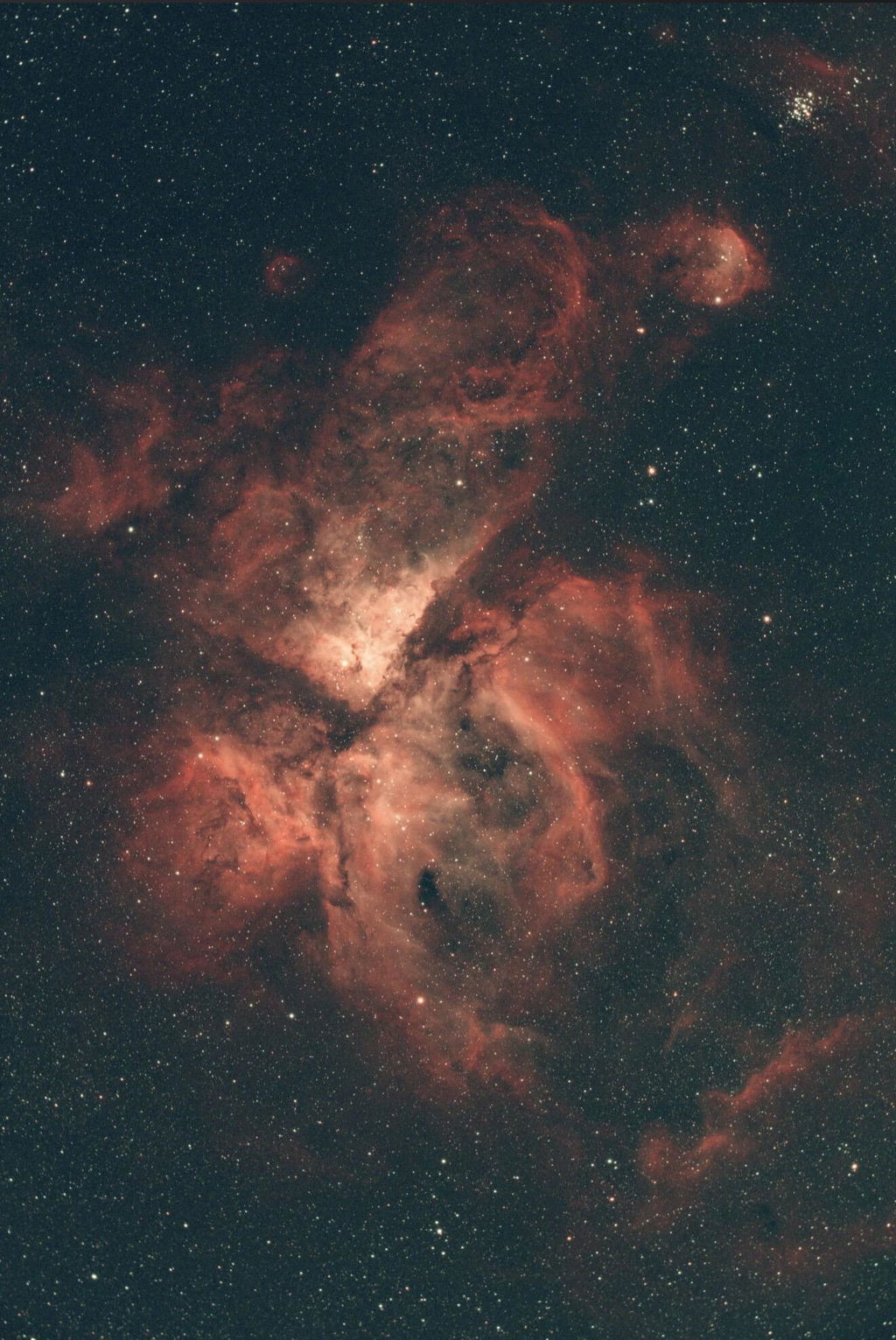
Have not had a chance to test yet but quality of manufacture looks good.